
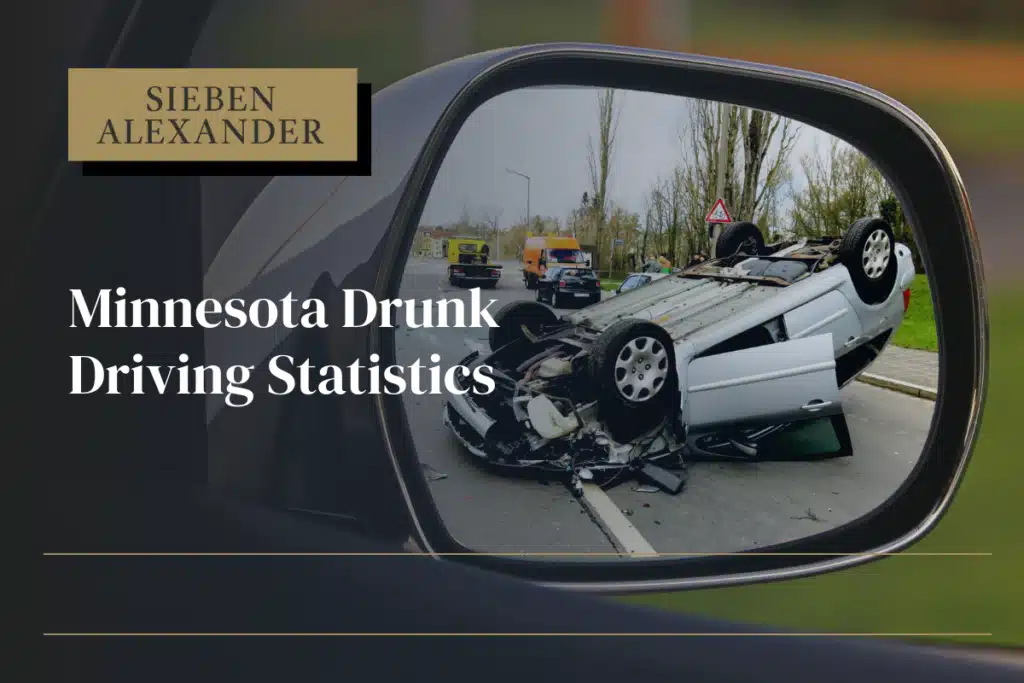
Drunk driving puts innocent lives at risk. According to Minnesota drunk driving statistics, one in every five auto accident fatalities in the state involves a drunk driver. Despite Minnesota’s strict laws against driving while impaired, many drivers still get behind the wheel when they’ve had too much to drink. Every year, drunk driving in Minnesota claims the lives of more than 100 people and injures thousands of others.
If you or a loved one were injured in an accident caused by a drunk driver, you are entitled to compensation. The legal team at Sieben Alexander P.A. can help. Our Eagan DUI accident lawyers are committed to fighting for justice on behalf of injury victims throughout the state. Call (651) 362-2108 or reach out online to schedule your free consultation today.
Minnesota Impaired Driving Statistics
Unfortunately, DUI statistics in Minnesota show that impaired driving is very common on our state’s roads. These accidents lead to thousands of injuries, and many are fatal.
- About one in seven Minnesotans has at least one DWI on their record, and more than 100,000 Minnesotans self-reported driving after drinking at least once during a 30-day period.
- In 2023, law enforcement made 26,909 DWI arrests across Minnesota.
- Alcohol-related crashes injured 1,647 people in Minnesota in 2023.
- DUI death statistics are also grim. In 2023, alcohol-related crashes contributed to 112 traffic deaths in Minnesota.
- It’s estimated that alcohol-related crashes cost Minnesota approximately $408 million in 2022.
Minnesota vs. the National Average
Impaired driving remains a serious public safety concern in Minnesota and across the country. According to the National Highway Traffic Safety Administration, 11,904 people were killed in motor vehicle crashes involving alcohol-impaired drivers in 2024, accounting for 32% of all traffic fatalities in the United States. On average, 32 people lose their lives every day in alcohol-impaired driving crashes, or about one person every 44 minutes.
The financial impact is equally significant. The CDC estimates that alcohol-impaired driving crashes cost approximately $143 billion nationwide in 2022.
Understanding Minnesota DUI Laws and BAC Limits
Minnesota has strict laws designed to discourage impaired driving and improve roadway safety. Understanding how blood alcohol concentration limits work, along with the circumstances that can lead to a DUI arrest, can help you better understand your rights and responsibilities under Minnesota law.
What Is the Legal Blood Alcohol Concentration (BAC) Limit in Minnesota?
Minnesota establishes different BAC limits depending on the age of the driver and the vehicle being operated. Drivers should remember that impairment can occur before reaching the legal limit, and law enforcement can still arrest a driver when there is probable cause to believe the driver is impaired, even if the BAC is under the legal limit.
The BAC limits include:
- Standard drivers: Drivers age 21 and older may not operate a vehicle with a BAC of 0.08% or higher.
- Commercial drivers: Drivers operating commercial motor vehicles are subject to a lower legal BAC limit of 0.04%.
- Drivers under 21: Minnesota’s Not a Drop law prohibits drivers younger than 21 from operating a vehicle after consuming any alcohol.
The Minnesota Implied Consent Law Explained
Minnesota’s implied consent law provides that anyone who drives, operates, or is in physical control of a motor vehicle in the state has already agreed to submit to chemical testing under certain circumstances. A peace officer may request a breath, blood, or urine test when there is probable cause to believe a driver violated Minnesota’s impaired driving laws and the legal requirements for testing have been met.
Before requesting a breath test, officers must advise drivers that Minnesota law requires the test. They must also explain that refusing a breath test is a crime. Officers must also inform drivers that they have a limited right to consult with an attorney, provided that doing so does not unreasonably delay testing. Blood and urine testing generally require a search warrant or another recognized legal exception.
The Four Degrees of Impaired Driving Charges in Minnesota
Minnesota classifies impaired driving offenses into four degrees. These are based on factors such as prior DWI convictions, aggravating circumstances, and the seriousness of the offense. As the degree increases, the potential criminal penalties become more severe.
Fourth-Degree DWI: Misdemeanor
Fourth-degree DWI generally applies to a first-time impaired driving offense. Potential penalties for a fourth-degree DWI include:
- Jail: Up to 90 days.
- Fine: Up to $1,000.
Drivers may also face license suspension.
Third-Degree and Second-Degree DWI: Gross Misdemeanors
Third-degree DWI generally applies when one aggravating factor is present, while second-degree DWI involves two or more aggravating factors. Aggravating factors include having a blood alcohol concentration of 0.16 or higher, a prior qualified impaired driving incident, or having a child under the age of 16 in the vehicle.
Potential penalties include:
- Jail: Up to one year.
- Fine: Up to $3,000.
In addition to fines and jail, penalties may include license suspension and required participation in Minnesota’s ignition interlock program. Drivers with one prior incident generally must participate for at least two years. If you have two prior incidents, you must participate for at least six years. If you have three or more prior incidents, you might have to participate for at least 10 years. Participants must also complete any required substance use treatment before full driving privileges can be restored.
First-Degree Felony DWI
First-degree DWI generally applies when a driver commits their fourth DWI incident within 10 years or has a prior felony DWI conviction.
Potential penalties include:
- Prison: Up to seven years, with a mandatory minimum imprisonment in many cases.
- Fine: Up to $14,000.
Additional consequences can include long-term driver’s license suspension or revocation and participation in Minnesota’s ignition interlock program when seeking license reinstatement. You may also have to complete a licensed substance use treatment or rehabilitation program before full driving privileges can be restored. You will also likely have a period of conditional release after imprisonment.
Injured by a Drunk Driver? Sieben Alexander Can Help
Minnesota’s impaired driving laws impose criminal penalties on drunk drivers. However, those penalties do not compensate the people who were injured by their actions. If an impaired driver caused your crash, you have the right to pursue a personal injury claim for the physical, financial, and emotional losses you have suffered.
For more than 50 years, Sieben Alexander, P.A., has represented injured Minnesotans in complex personal injury cases. Our attorneys understand the legal terrain of Minnesota and the Upper Midwest. We provide individually tailored legal services and the necessary resources for handling serious injury litigation. Our car accident lawyers build well-supported claims that position our clients for the best possible results while they focus on their recovery.
Call (651) 362-2108 or fill out our online contact form to schedule your free consultation with an experienced Minnesota drunk driving accident attorney today. You pay nothing unless we win your case.
Sources
Centers for Disease Control and Prevention. “Impaired Driving Facts.” Centers for Disease Control and Prevention, Accessed 30 June 2026, https://www.cdc.gov/impaired-driving/facts/index.html
Minnesota Department of Health. “Driving While Impaired by Alcohol.” Minnesota Department of Health, Accessed 30 June 2026, https://www.health.state.mn.us/communities/alcohol/basics/impaireddriving.html.
National Highway Traffic Safety Administration. “Drunk Driving.” U.S. Department of Transportation, Accessed 30 June 2026, https://www.nhtsa.gov/risky-driving/drunk-driving.
Office of Traffic Safety. “2023 Minnesota Crash Facts.” Minnesota Department of Public Safety, Accessed 30 June 2026, https://assets.dps.mn.gov/files/ots/2023_Minnesota_Crash_Facts.pdf.
Office of Traffic Safety. “Impaired Driving Laws.” Minnesota Department of Public Safety, Accessed 30 June 2026, https://dps.mn.gov/divisions/ots/safe-driving-information-and-laws/traffic-safety-laws/impaired-driving-laws.
National Highway Traffic Safety Administration. “Overview of Motor Vehicle Traffic Crashes in 2024.” U.S. Department of Transportation, Accessed 30 June 2026, https://crashstats.nhtsa.dot.gov/Api/Public/ViewPublication/813791.