
Secondary Asbestos Exposure in Minnesota: Can You File a Mesothelioma Lawsuit?
For many people with no history of occupational asbestos exposure, the source of their mesothelioma may be baby powder, body powder, or cosmetics contaminated with asbestos fibers. Recent Minnesota talcum powder lawsuits have drawn greater attention to the dangers of these products.

Home | Minnesota Asbestos Exposure Lawyers | Secondary Asbestos Exposure in Minnesota
Navigate This Page
- What Is Secondary Asbestos Exposure?
- Who Is Most at Risk for Take-Home Asbestos Exposure?
- Can You File a Mesothelioma Lawsuit for Secondary Asbestos Exposure from a Spouse’s Work Clothes?
- What Is the Statute of Limitations for Secondary Asbestos Exposure?
- Why You Need an Experienced Mesothelioma Lawyer for a Secondary Asbestos Exposure Case
- Why Choose Sieben Alexander for Your Minnesota Mesothelioma Case?
- Contact a Minnesota Secondary Asbestos Exposure Lawyer
- Frequently Asked Questions About Secondary Asbestos Exposure in Minnesota
If you or a loved one developed mesothelioma due to take-home asbestos exposure, Sieben Alexander, P.A. can help you understand your legal options. With over 50 years of experience, our Minnesota asbestos exposure lawyers have recovered more than $900 million for victims and their families.
What Is Secondary Asbestos Exposure?
Secondary asbestos exposure occurs when someone comes into contact with asbestos fibers carried home from another person’s workplace. It’s sometimes called take-home asbestos exposure.
When a worker in a high-risk industry disturbs asbestos-containing materials, the microscopic asbestos fibers can become airborne and settle on their clothing, skin, hair, or work tools. Without proper decontamination procedures, the worker may carry those fibers home, where their family members may then inhale or ingest them. Decades later, those family members may develop mesothelioma, asbestosis, lung cancer, and other asbestos-related diseases.
Workers in many industries have unknowingly transported asbestos fibers home from their job sites, including:
- Construction and demolition
- Roofing
- Automotive repair
- Shipbuilding and shipyard work
- Insulation installation
- Plumbing and pipefitting
- Steel manufacturing
- Tile installation
- Power plant work
- Welding
- Electrical repair
- Drywalling
- Bricklaying
- Refinery work
Who Is Most at Risk for Take-Home Asbestos Exposure?
The people most at risk of secondary asbestos exposure are those who lived with a worker who regularly handled or worked near asbestos-containing materials. These most commonly include spouses and children, but other household members can also be at risk.
Spouses
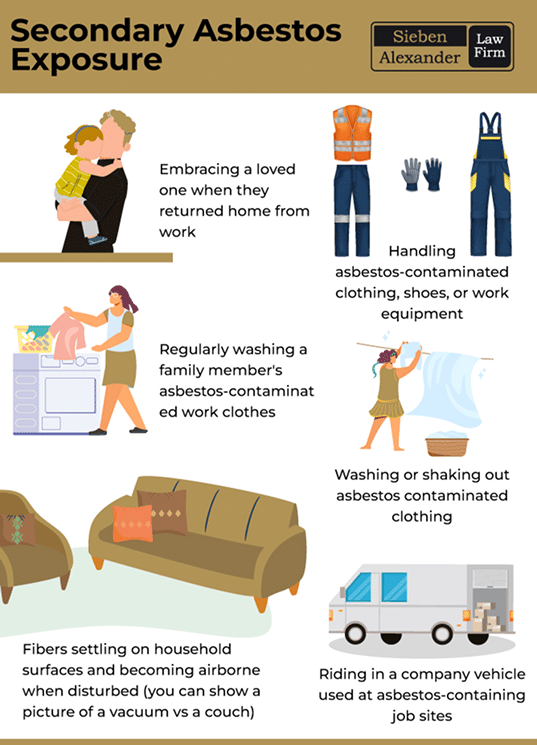
For many spouses of high-risk workers, asbestos exposure happened through everyday household routines. They may have washed or shaken out dusty work clothes, cleaned areas where the worker kept contaminated equipment, or greeted their spouse before changing clothes or showering. Fibers could also spread to sheets and pillows on shared sleeping surfaces, creating another source of repeated exposure for spouses.
Children
Many children were exposed simply by being close to a parent who worked around asbestos. A child might have sat on the worker’s lap or hugged them when they came home. Young children were especially likely to spend time on floors or other surfaces where asbestos dust had accumulated.
Children
Many children were exposed simply by being close to a parent who worked around asbestos. A child might have sat on the worker’s lap or hugged them when they came home. Young children were especially likely to spend time on floors or other surfaces where asbestos dust had accumulated.
Other Household Members
Parents, siblings, roommates, or anyone else who shared a home with an asbestos worker may also have experienced repeated secondary exposure. Fibers carried into the home could settle into carpets or sofas, only to be made airborne again when household members interacted with the fabrics. They may also have been exposed to asbestos when cleaning contaminated surfaces throughout the home or riding in the worker’s vehicle.
Can You File a Mesothelioma Lawsuit for Secondary Asbestos Exposure from a Spouse's Work Clothes?
Minnesota courts have recognized that people harmed by take-home exposure may have the right to sue for asbestos exposure. If you developed mesothelioma after being exposed to asbestos carried home by a spouse or another household member, you may be eligible to pursue compensation from the responsible companies.
Throughout the 20th century, many companies knew or should have known that asbestos fibers were dangerous and could travel home with workers. Despite this knowledge, they often failed to take reasonable precautions to prevent workers from exposing their families, such as:
- Warning workers about the risk of take-home asbestos exposure
- Providing on-site changing rooms and showers
- Supplying protective clothing
- Allowing workers to keep contaminated work clothes at the job site
- Offering on-site laundry services for work clothes
- Implementing proper dust control procedures
Evidence showing a lack of reasonable precautions could support a secondary exposure claim against the manufacturers that supplied the asbestos-containing products or the companies that controlled the contaminated job sites.
Have Questions About Your Case? We’re Here to Help.
Call 651-362-2108 today for a free consultation.
What Is the Statute of Limitations for Secondary Asbestos Exposure?
The statute of limitations determines how long you have to file a claim for mesothelioma compensation in Minnesota. Under state law, you typically have four years from the date of diagnosis to file a secondhand asbestos exposure lawsuit. If you lost a loved one to an asbestos-related disease, you have three years from the date of death to file a wrongful death lawsuit.
Asbestos trust fund claims are often subject to different deadlines. Regardless of what option you pursue, missing your case’s filing deadline may prevent you from recovering compensation.
Because asbestos fibers do not cause an immediate injury, you generally cannot sue for asbestos exposure before you become ill. The right to sue arises only after you develop an asbestos-related disease.
Minnesota's Discovery Rule Is Critical
Mesothelioma takes decades to develop after asbestos exposure, often after a latency period of 20 to 60 years. Minnesota’s asbestos discovery rule prevents the statute of limitations from expiring during that long latency period. Rather than starting when the exposure occurred, the timer only begins running when the disease is diagnosed.
While mesothelioma is almost always caused by asbestos exposure, some illnesses—such as lung cancer—can have several possible causes. In those cases, the filing deadline may depend on when the patient knew or reasonably should have known that asbestos contributed to the disease. If there was a delay in identifying that the disease was linked to asbestos exposure, that may extend the time you have to file.
Time can move quickly after an asbestos-related diagnosis. The sooner you contact our Minnesota asbestos attorneys, the better positioned we’ll be to pursue fair compensation on your behalf.
Why You Need an Experienced Mesothelioma Lawyer for a Secondary Asbestos Exposure Case
Secondary exposure cases require the investigation to go a step further than most asbestos exposure claims. Comprehensive evidence is necessary to connect a current diagnosis, a household member’s work history, the patient’s history of living with that person, and the asbestos-containing products present at the workplace.
With over 50 years of experience investigating asbestos cases, our attorneys have a deep understanding of the industries, job sites, products, and companies that exposed Minnesota workers and their families to harmful asbestos fibers. We can draw on that experience to reconstruct events from decades ago and build a strong case using evidence such as:
- Employment and union records
- Military service records
- Residential records showing when the patient and the worker lived together
- Testimony from coworkers or family members
- Workplace documents identifying whether any decontamination procedures were in place
- Job site inspection reports
- Records identifying the asbestos-containing products used at the workplace and the companies that manufactured them
- Medical records confirming the asbestos-related diagnosis
Why Choose Sieben Alexander for Your Minnesota Mesothelioma Case?
As the only Minnesota law firm actively representing people with mesothelioma, we have what it takes to investigate complex asbestos exposure cases and stand up to the powerful corporations behind these claims.
Our team has spent decades advocating for clients affected by asbestos-related diseases. In that time, we’ve recovered more than $900 million in settlements and verdicts and earned numerous positive client testimonials. Our recent results include two historic verdicts worth $65.5 million and $10.2 million for victims of asbestos exposure who developed mesothelioma.
When you turn to us for help after receiving a diagnosis linked to asbestos exposure, we’ll use our extensive resources to examine your family’s work history and establish how it contributed to your illness decades later. We’ll then pursue every available source of compensation on your behalf, whether that’s filing a lawsuit against the responsible company or filing an asbestos trust fund claim.
How Can We Help?
"*" indicates required fields
Contact a Minnesota Secondary Asbestos Exposure Lawyer
A mesothelioma diagnosis can leave your family with more questions than answers, especially if you don’t have a history of working with asbestos-containing materials. If you suspect a current illness may be related to asbestos exposure from a family member, you have an ally in Sieben Alexander. No matter how long ago your exposure may have occurred, we’re prepared to trace the source and pursue the compensation you and your loved ones deserve.
Fill out our online contact form or call 651-362-2108 to discuss your case confidentially with one of Minnesota’s premier mesothelioma lawyers. Your consultation is free, and we charge no fees unless we recover compensation on your behalf.
No-Obligation Consultation
Every case begins with a free consultation. We listen to your experience, understand its impact, and identify what you need to move forward with your case.
Open & Honest Communication
You will have direct access to the team working on your case. We maintain open communication and keep you informed about your case at every stage.
No-Fees Unless We Win
From day one, we are fully committed to your case. We gather evidence, negotiate with insurers, and prepare for trial if necessary. You pay nothing unless we secure compensation for you.





Frequently Asked Questions About Secondary Asbestos Exposure in Minnesota
Explore our answers to common questions from people affected by take-home asbestos exposure in Minnesota.
Can I File a Lawsuit if I Got Mesothelioma From My Spouse's Work Clothes?
Yes. If your spouse carried home asbestos fibers on their work clothes and you later developed mesothelioma, you may have the right to file a secondhand asbestos exposure lawsuit against the liable parties.
What Is the Statute of Limitations for Secondary Asbestos Exposure in Minnesota?
The deadline for filing a take-home mesothelioma lawsuit is the same as the deadline for other asbestos exposure cases. Minnesota’s statute of limitations typically gives a living patient four years from the date of their asbestos-related diagnosis to file a lawsuit. If the patient has died, the family has three years from the date of death to file a wrongful death lawsuit.
How Long Does It Take for Mesothelioma to Develop After Take-Home Asbestos Exposure?
Most mesothelioma diagnoses occur about 20 to 60 years after a person experiences take-home asbestos exposure. As a result, many patients do not immediately connect their current symptoms to their household member’s job from decades earlier.
Can Children Develop Mesothelioma From Secondhand Asbestos Exposure?
Due to its long latency period, asbestos-related mesothelioma is exceptionally rare in children. More commonly, a child exposed to asbestos at home may develop the disease decades later in adulthood.
Do I Need to Know Exactly Where the Asbestos Exposure Happened?
No, you do not need to know where you or your loved one encountered asbestos before contacting our Minnesota mesothelioma lawyers. After we confirm that you’ve been diagnosed with an asbestos-related disease, we can investigate the likely source of exposure.