
Talcum Powder and Asbestos: Contaminated Products & Testing
Baby powder and makeup are familiar products, so finding out that some have tested positive for asbestos can raise unsettling questions about your health and safety.
FDA testing has identified contamination in certain talc-containing products. Those records offer a starting point for researching past use, but understanding what they reveal requires a closer look at the products tested.
Home | Contaminated Products & Testing
- Talc can contain asbestos because the minerals naturally occur in close proximity, creating a risk of contamination during mining.
- Asbestos has been found in certain personal care products, though not every talc-containing product is contaminated.
- Testing results are product-specific and cannot establish whether every product sold under the same brand contained asbestos.
- FDA testing records identify products, manufacturing lots, and laboratory findings that can help consumers research potential contamination.
- Historical exposure can be investigated using product information, purchase records, scientific studies, and personal recollections.
Can Talcum Powder Contain Asbestos?
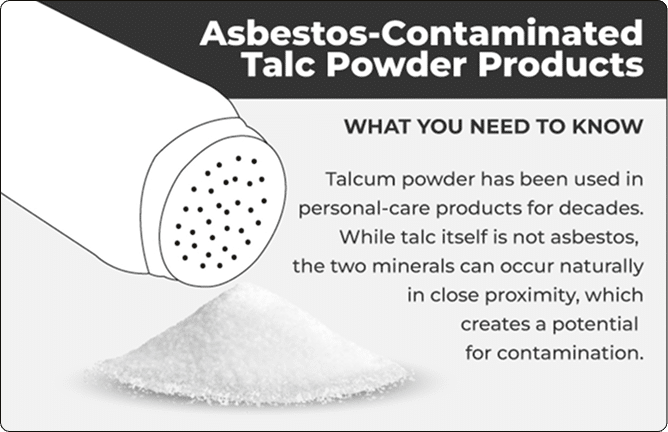
Talcum powder can contain asbestos because talc and asbestos are naturally occurring minerals that can form near one another underground. When talc is mined, asbestos fibers can become mixed with the mineral and potentially enter products made from it.
The U.S. Food and Drug Administration (FDA) has identified asbestos in certain talc-containing cosmetic samples during product testing. However, not all talcum powder contains asbestos. Seeing talc listed as an ingredient doesn’t mean a product is contaminated. Testing is necessary to identify whether asbestos is present.
Why Does Asbestos in Talcum Powder Matter?
When asbestos-contaminated talcum powder becomes airborne, people can inhale microscopic fibers that can lodge in their lungs. Exposure to asbestos increases the risk of several serious diseases, some of which take decades to develop.
According to the Agency for Toxic Substances and Disease Registry (ATSDR), asbestos exposure can cause:
- Mesothelioma: Cancer affecting the lining of the lungs, abdomen, or other organs
- Lung cancer: Cancer that develops in lung tissue
- Asbestosis: Permanent lung scarring that makes breathing difficult
- Pleural disease: Changes to the lining around the lungs, sometimes involving thickening or fluid buildup
- Other cancers: Cancers of the larynx (voice box) and ovaries
Exposure doesn’t mean someone will develop an asbestos-related illness. If you’re concerned about past exposure, speak with a medical professional about your history and schedule any appropriate follow-up care.
Which Types of Talc Products Have Been Tested for Asbestos?
The FDA’s Asbestos testing has examined a variety of talc-containing personal care products, from baby powder and body powders to everyday cosmetics.
Many of these products contain loose powder that can be released into the air when shaken or applied. If asbestos is present, someone using the product or standing nearby could inhale the fibers.
Testing results vary by product and sample, making it important to examine the findings for individual products instead of assuming an entire category is contaminated.

Baby Powder
Talc-based baby powder has historically been used to absorb moisture and reduce friction on the skin. Although marketed for infant care, these products are commonly used by adults for personal hygiene.
Baby powder has been a focal point of asbestos testing and product recalls. In 2019, the FDA identified chrysotile asbestos in a sample of Johnson’s Baby Powder, prompting a voluntary recall of Lot #22318RB. This recall highlights the importance of being able to identify lot numbers for a more accurate comparison with FDA records.
Body and Dusting Powders
Body and dusting powders can become such a familiar part of getting dressed that someone might use the same product for years without thinking much about its ingredients. Talc has been used in these powders to absorb moisture and reduce friction, especially around the feet and underarms.
The FDA has tested several talc-based body powders for asbestos contamination. Its 2019 testing records show that samples of Gold Bond Ultimate Men’s Essentials Body Powder and Enchanteur Charming Perfumed Talc both tested negative for asbestos.
These findings apply to the specific samples examined and don’t establish whether other batches or older formulations contained asbestos.
Cosmetic Powders
Talc can appear in several products in the same makeup bag. Face powders, blushes, eyeshadows, and contour palettes use it to absorb moisture and give makeup a smoother feel. Someone who has never used baby powder could still have used talc-containing cosmetics.
Cosmetic powders have also been linked to documented asbestos contamination. In 2019, the FDA identified tremolite asbestos in samples of three Claire’s makeup products: Eye Shadows (Lot 08/17), Compact Powder (Lot 07/15), and Contour Palette (Lot 04/17).
Claire’s subsequently issued a voluntary recall of the affected products. The findings were specific to the tested lots and do not establish that all cosmetics sold by the company contained asbestos.
Medicated and Specialty Powders
Some talc-containing products are chosen for a particular problem, like itchy skin or visible hair roots. Medicated powders can combine talc with ingredients that relieve irritation. Certain hair powders use it in formulas designed to conceal thinning areas or cover roots between color appointments.
Some of these products have appeared in federal asbestos testing records. In 2023, the FDA tested Hairgenetics Root Cover Up and Style Edit Root Touch Up, but did not find asbestos in either sample.
For someone researching hair powder, these records show that FDA testing has extended beyond skin care and makeup. The negative findings apply to the samples tested.
Why Were Some Talc Products Contaminated?
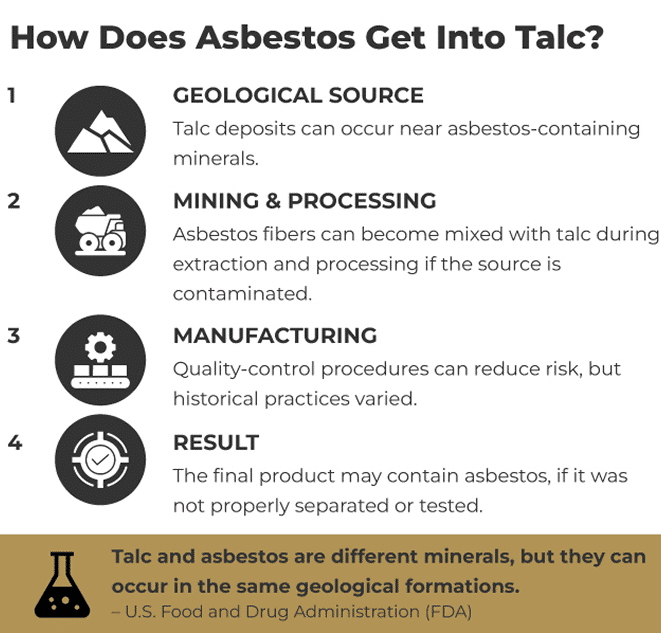
The risk of asbestos contamination begins where talc is mined. Both minerals can occur within the same geological deposits, allowing asbestos fibers to become mixed with talc before it reaches a manufacturer.
Careful selection of mining sites, purification processes, and quality-control testing can help reduce this risk. However, removing asbestos from talc ore can be difficult, and mining practices, processing methods, and testing standards have changed over time.
A familiar brand name can stay on the shelf for decades even as its suppliers or manufacturing practices change. That’s why the years you used a product matter. Records about its talc source and manufacturing location can help you connect your own use history with findings from that period.
How Can You Research a Historical Talcum Powder Product?
If you suspect a talcum powder product you used years ago contained asbestos, start by gathering any details you remember about it. For example, a photograph of an old bathroom shelf or a relative’s recollection could help identify a product even if you no longer have the container. Details that help include:
- Product details: Brand and product name, manufacturer, packaging appearance, a lot or batch number, manufacturing location
- Purchase history: Approximate purchase dates, stores where you purchased the product, receipts or other purchase records
- Exposure history: Years and frequency of use, how you applied the powder, whether you remember dust rising during application, whether someone else regularly applied it near you
Once you’ve identified the product, you can compare those details with FDA talc testing records, scientific studies, and historical manufacturing information. These resources can help determine whether asbestos contamination was documented in specific products, manufacturing periods, or talc sources.
What Talc Testing Can and Cannot Tell You
Asbestos testing can establish whether contamination was detected in a particular talc sample, but the findings have limits. There is no single list that identifies every talc product or brand that has contained asbestos.
Test results typically apply to the specific product, sample, or manufacturing lot examined. A positive finding doesn’t mean every product sold under that brand contained asbestos. Likewise, a negative result doesn’t establish that other batches, older formulations, or products from the same manufacturer were asbestos-free.
The question is whether a finding sheds light on the product you actually used. A matching brand name is a starting point, but matching dates and lot information can make the record more relevant to your history.
FDA Talc Testing Records
The FDA publishes testing records that help consumers research whether asbestos was detected in selected talc-containing cosmetics. Depending on the report, these records identify the manufacturer, brand, product name, lot or batch number, FDA sample identification number, and laboratory findings.
The FDA has used two laboratory methods to examine samples:
- Polarized light microscopy (PLM): This technique uses polarized light to help identify minerals based on their optical properties.
- Transmission electron microscopy (TEM): This technique uses electron imaging and analytical techniques to examine extremely small fibers and identify their composition.
You might find a familiar product in these reports, but many products won’t appear at all. The FDA tests selected samples, so its records cannot answer every question about a powder used years ago. A product’s absence from the reports doesn’t tell you whether it contained asbestos.
FDA Talc Testing Results by Year
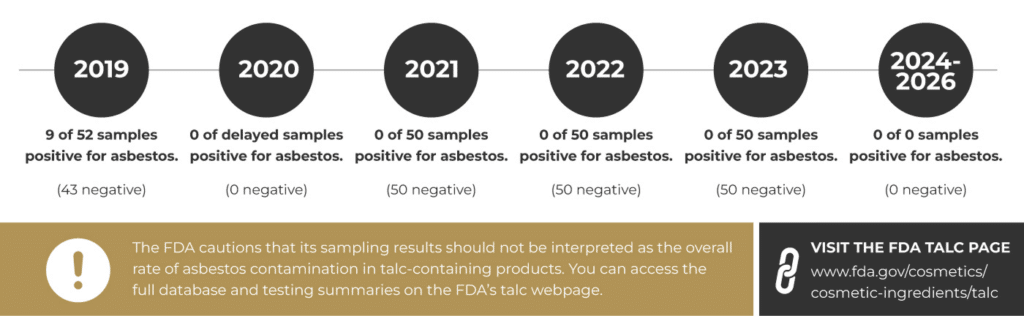
The FDA’s published testing results show how asbestos findings have varied across different sampling periods. Its 2019 testing identified asbestos in nine samples, but no asbestos was detected in the samples examined during 2021, 2022, or 2023.
The FDA’s 2020 sampling assignment was postponed until 2021 because of the COVID-19 pandemic. The agency released its most recent published annual sampling results in April 2024, covering products tested in 2023.
Read each year’s results as a record of the samples examined during that testing period. A year with no positive findings doesn’t settle questions about products sold earlier or batches that weren’t tested.
Understanding Your Asbestos Exposure History
You may remember the powder on a parent’s dresser more clearly than its name. Or you may know exactly what you used but have no packaging left to check. Either can be a place to start.
Write down what you remember before searching the records, and keep track of what you find. Some details will match up, but others may remain uncertain. You can build a record of your product use without being able to answer every question about contamination.
If you’re concerned about your health, share that history with a medical professional. An attorney who handles asbestos claims can address questions about whether the information supports further legal investigation.
Resources
- Agency for Toxic Substances and Disease Registry. (2026, August 26). Asbestos and your health.
- Agency for Toxic Substances and Disease Registry. (2026, August 26). Health effects of asbestos.
- U.S. Food and Drug Administration. (2019, October 18). Baby powder manufacturer voluntarily recalls product for asbestos.
- U.S. Food and Drug Administration. (n.d.). FDA advises consumers to stop using certain cosmetic products.
- U.S. Food and Drug Administration. (n.d.). FDA summary of results from testing of official samples of talc-containing cosmetics for asbestiform fibers by AMA Laboratories during FY19.
- U.S. Food and Drug Administration. (n.d.). FDA summary of results from testing of official samples of talc-containing cosmetics for asbestiform fibers completed by AMA Laboratories in 2023.
- U.S. Food and Drug Administration. (n.d.). Talc.