
Minnesota Workplace Disability Statistics
Disability affects many Minnesotans in the workplace. While employment can help disabled workers achieve better financial outcomes, those workers may face difficulties in finding and maintaining jobs, especially in certain occupations. Disabled Minnesotans live with a number of conditions, including cognitive difficulties, impaired vision, limited hearing, or difficulty walking.


Home | Minnesota Workplace Disability Statistics
Navigate This Page
Key Workplace Disability Statistics in Minnesota
Nearly 13% of Minnesotans 16 and older have a disability, but they only make up 5.8% of the workforce. Another set of data, compiled in 2023, shows that 55.6% of disabled adults work in Minnesota. Disability trends in Minnesota show a small increase in the overall disabled population since 2008.
You’ll find disabled workers in every industry in Minnesota, but they are more common in some. The top industries are:
- Educational services, health care, and social assistance: 25.9%
- Manufacturing: 13.5%
- Professional, scientific, and management, plus administrative and waste management services: 10.5%
- Retail trade: 10.4%
- Arts, entertainment, and recreation, and accommodation and food services: 7.3%
People with disabilities are also more likely to work in certain occupations, including:
- Production, transportation, and mineral moving
- Sales and office
- Service
Disabled Minnesotans live all over the state, with a slight majority living in the Twin Cities area.

Common Disabilities in the Workplace
Disabilities in the Minnesota workplace are varied, and some workers have multiple disabilities or a disability that affects various areas of their lives. Because many people report more than one limitation, percentages exceed one hundred percent.
- 53% of the working disabled population has a cognitive difficulty
- 26% have an independent living difficulty
- 23% have a hearing disability
- 21% have an ambulatory difficulty
- 13% have vision difficulties
- 7% have a self-care difficulty
These broad categories represent a range of mental and physical disabilities in Minnesota workplaces. Cognitive difficulties, for instance, refer to any physical, mental, or emotional issue that affects memory, attention, or decision-making. That could include dyslexia, autism, or ADHD, as well as depression, anxiety, or even chronic pain. An ambulatory difficulty refers to any problem walking or climbing stairs, which could mean cerebral palsy, lower back injuries, or a degenerative disease such as Parkinson’s.
Workplace Disability in Minnesota Versus the National Average
From 2008 to 2023, the number of Minnesotans living with a disability increased from 9.6% to 11.8%. Minnesota has a slightly lower percentage of disabled residents than the country as a whole.
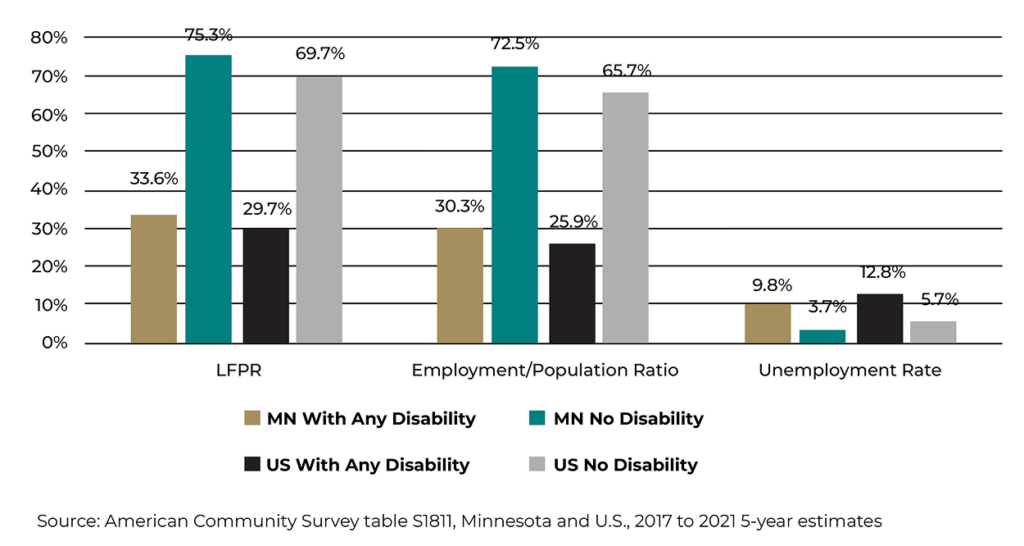
From 2017 to 2021, 33.6% of people over 16 with disabilities were in the Minnesota workforce, compared with 75.3% of those without disabilities. The national statistics over the same time were 29.7% and 69.7%, respectively. In terms of workplace participation, Minnesota is ahead of the curve.
Though the number of disabled Minnesotans in the workforce has increased in recent years, there’s still a Minnesota disability employment gap. Labor force participation is far lower for disabled Minnesotans than for the non-disabled population.

Disability by Location and Demographic
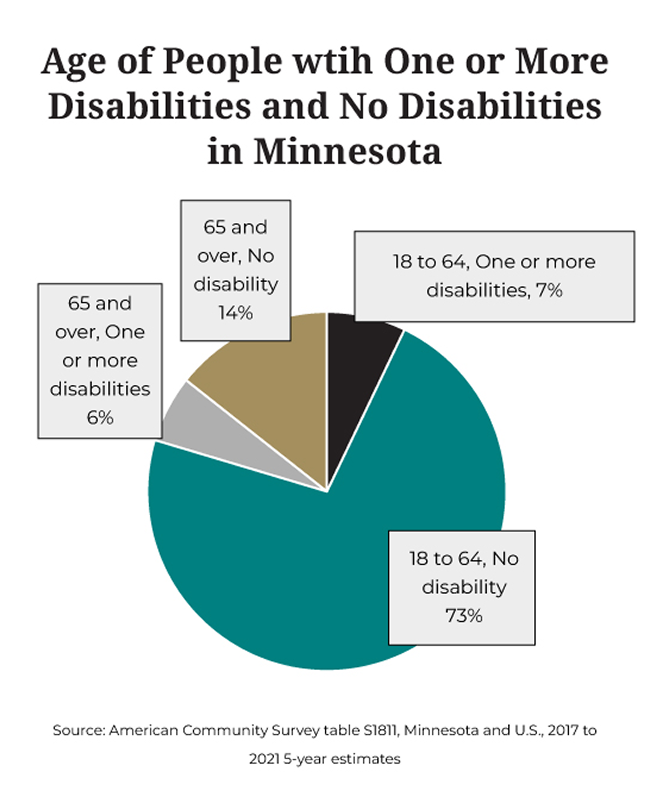
Disability location data in Minnesota generally follows broader population trends. Fifty-five percent of Minnesota’s overall population lives in the Twin Cities region, which is also home to just over half the state’s disabled population, 334,257 disabled residents.
People with disabilities are a vital part of communities all across Minnesota.
| City | Percentage of Population With at Least One Disability (2019-2023) | Total Disabled Population |
|---|---|---|
| Brainerd | 20% | 2,809 |
| Bemidji | 17.30% | 2,600 |
| Duluth | 14.30% | 12,230 |
| St. Cloud | 13.70% | 9,348 |
| Sauk Rapids | 12.10% | 1,639 |
| Winona | 11.70% | 2,999 |
| Mankato | 11.60% | 5,138 |
| Rochester | 10.10% | 12,133 |
| Elk River | 9.20% | 2,366 |
While fewer disabled people live in Minnesota’s rural regions overall, those residents may face additional challenges accessing the services they need.
$8.05M
VERDICT
Our client was a pipefitter who had been exposed to asbestos while working at a refinery. Sieben Alexander filed a lawsuit on his behalf, resulting in an $8,050,000 jury verdict.
$5M
SETTLEMENT
A retired Minneapolis pipefitter developed an asbestos-related illness after working with asbestos-containing equipment and defective protective masks. Our attorneys recovered over $5,000,000 for him before the case reached trial.
$4.6M
SETTLEMENT
A Northern States Power Company (NSP) worker was exposed to asbestos from gaskets. Our firm secured a $4,600,000 jury award that was successfully affirmed by the Minnesota appellate courts.
$4.6M
SETTLEMENT
Our client was a retired certified public accountant who spent just one summer in the late 1950s working as an asbestos insulator. Sieben Alexander represented him in a 2014 lawsuit, securing a $4,600,000 jury award.
$4.6M
SETTLEMENT
Our client developed mesothelioma after working with asbestos-containing pipe covering for only a few months during the construction of a power plant. Our firm, alongside co-counsel, obtained a verdict of more than $4,000,000 against the product manufacturer.
$3M
SETTLEMENT
A local man was severely injured in a work-related explosion. Sieben Alexander, P.A. pursued a legal claim on his behalf, recovering over $3,000,000.
$3M
SETTLEMENT
Our client, a retired Twin Cities pipefitter was diagnosed with mesothelioma in 2019 following decades of asbestos exposure. Sieben Alexander recovered $3,000,000 on behalf of the retired worker and his wife.
$2.5M
SETTLEMENT
A local couple sustained severe injuries in a car crash. Our firm represented the couple in their case against the responsible parties, resulting in a recovery of over $2,500,000.
$1.6M
SETTLEMENT
A local woman was severely injured in a car crash. Sieben Alexander, P.A. navigated multiple layers of insurance coverage to secure a recovery of over $1,600,000.
$1.35M
SETTLEMENT
A victim suffered severe burns during a service station explosion. The firm negotiated on behalf of the victim, achieving a $1,350,000 settlement.
$1.25M
SETTLEMENT
A woman tragically lost her life in a car crash. Sieben Alexander represented her family in a wrongful death claim, recovering $1,250,000.

Lisa and I have been very happy with John and his law firm [Sieben Alexander, P.A.]. His attention to detail is unmatched. This is our first time dealing with an injury lawsuit and John and Joleen have been great reassuring us through every step in the process. I would highly recommend John to anyone needing legal help. Top notch!!
Ken
Working with John and Alex was a breeze. They took the time to help be prepared for the deposition, planned ahead with 3rd party Doctor assessments, and obtained a very suitable resulting settlement. I would definitely refer their services to anyone that needed it.
Mark M.
Working with John and Alex was a breeze. They took the time to help be prepared for the deposition, planned ahead with 3rd party Doctor assessments, and obtained a very suitable resulting settlement. I would definitely refer their services to anyone that needed it.
Mark M.
Working with John and Alex was a breeze. They took the time to help be prepared for the deposition, planned ahead with 3rd party Doctor assessments, and obtained a very suitable resulting settlement. I would definitely refer their services to anyone that needed it.
Mark M.
Working with John and Alex was a breeze. They took the time to help be prepared for the deposition, planned ahead with 3rd party Doctor assessments, and obtained a very suitable resulting settlement. I would definitely refer their services to anyone that needed it.
Mark M.
Working with John and Alex was a breeze. They took the time to help be prepared for the deposition, planned ahead with 3rd party Doctor assessments, and obtained a very suitable resulting settlement. I would definitely refer their services to anyone that needed it.
Mark M.
Working with John and Alex was a breeze. They took the time to help be prepared for the deposition, planned ahead with 3rd party Doctor assessments, and obtained a very suitable resulting settlement. I would definitely refer their services to anyone that needed it.
Mark M.
Working with John and Alex was a breeze. They took the time to help be prepared for the deposition, planned ahead with 3rd party Doctor assessments, and obtained a very suitable resulting settlement. I would definitely refer their services to anyone that needed it.
Mark M.
Working with John and Alex was a breeze. They took the time to help be prepared for the deposition, planned ahead with 3rd party Doctor assessments, and obtained a very suitable resulting settlement. I would definitely refer their services to anyone that needed it.
Mark M.
Working with John and Alex was a breeze. They took the time to help be prepared for the deposition, planned ahead with 3rd party Doctor assessments, and obtained a very suitable resulting settlement. I would definitely refer their services to anyone that needed it.
Mark M.
Have Questions About Your Case? We’re Here to Help.
Call 651-362-2108 today for a free consultation.
Sector and Occupation of Employment
While you can find disabled Minnesotans working in every part of the economy, they are slightly more likely than non-disabled workers to:
- Be an unpaid employee in a family business
- Be self-employed in a non-incorporated business
- Work in the private, nonprofit sector
Disabled adults are slightly underrepresented in the government and for-profit sectors.
While differences by sector between disabled and non-disabled workers are relatively small, the differences by occupation are more pronounced. When compared to the non-disabled population, disabled workers in Minnesota are:
- 51% more likely to work in production, transportation, and material moving
- 44% more likely to work in service occupations
- 4% more likely to work in sales
Disabled Minnesotans are underrepresented in certain occupations. When compared to the non-disabled population, disabled Minnesota workers are:
- 33% less likely to work in management, business, science, and arts occupations
- 19% less likely to work in natural resources, construction, and maintenance
These statistics show that disabled Minnesotans still face barriers in certain occupations and parts of the economy.
Poverty Status
Whether employed or unemployed, disabled Minnesotans have worse financial outcomes than non-disabled Minnesotans.
The number of disabled Minnesotans living in poverty amounts to 24.2%, compared with 24.9% nationwide. Disabled Minnesotans are more than three times as likely to live in poverty compared to non-disabled Minnesotans.
Disabled workers, however, are only a little more than twice as likely to be in poverty when compared to non-disabled workers. This shows why adequate employment access is so important for disabled workers.

The Legal Framework for Working With a Disability in Minnesota
Disability laws in Minnesota build on the Americans with Disabilities Act. Under the ADA, your employer cannot discriminate against you in hiring, firing, pay, or treatment provided you are qualified to do the job. Your employer is also forbidden from retaliating against you if you ask for an accommodation or raise a complaint.
Employers must offer reasonable accommodations to the job or work environment. There’s no set definition of a reasonable accommodation. It’s simply any change an employer can make without taking on undue hardship. That looks different for each workplace, but can include:
- A modified schedule
- Modified equipment, such as a different desk chair
- A workspace in a different part of the building
Workers with disabilities in Minnesota are also protected by the Minnesota Human Rights Act. The MHRA builds on the rights set out in the ADA. While the ADA only applies to workplaces with 15 or more employees, the MHRA applies in workplaces of any size.

How Can We Help?
"*" indicates required fields
The Impact of Workplace Disabilities on Employees and Employers
On the employee side, disabilities can make it more difficult to find, keep, and advance in a job. Workers often struggle to earn enough or secure needed accommodations from an employer.
Employers, on the other hand, may misunderstand their legal obligations to disabled employees or not know about resources available to help them. Employers may also have personal misconceptions about a disabled employee’s abilities.
The impact of disabilities on Minnesota workers can’t be understated. Employers also bear significant expenses regarding workplace disability claims in Minnesota. In 2023, the cost of the Minnesota workers’ compensation system was $1.8 billion, which works out to $0.91 per $100 of payroll.
No-Obligation Consultation
Every case begins with a free consultation. We listen to your experience, understand its impact, and identify what you need to move forward with your case.
Open & Honest Communication
You will have direct access to the team working on your case. We maintain open communication and keep you informed about your case at every stage.
No-Fees Unless We Win
From day one, we are fully committed to your case. We gather evidence, negotiate with insurers, and prepare for trial if necessary. You pay nothing unless we secure compensation for you.





Frequently Asked Questions About Workplace Disability in Minnesota
Both employees and employers have plenty of questions about workplace disability in Minnesota.
What Are the Most Common Workplace Disabilities in Minnesota?
About half of disabled Minnesota workers have a cognitive difficulty, or a condition that can affect concentration, memory, and decision-making. This category covers a wide variety of physical and mental conditions, including developmental disabilities, depression, and autism spectrum disorders.
What Legal Protections Do Workers With Disabilities Have in Minnesota?
Workers with disabilities are prevented from discrimination in all aspects of employment, from recruitment to vacation time. While the ADA only applies to workplaces with more than 15 employees, the MHRA extends those protections to workers at all places of employment.
How Do Workplace Disabilities Affect Employer Responsibilities in Minnesota?
Regardless of size, employers aren’t allowed to discriminate against a disabled person in hiring, firing, pay, or benefits unless the discrimination is related to a clear job requirement. Employers must also engage in an interactive process if an employee asks for a reasonable accommodation.
What Resources Are Available for Minnesota Workers With Disabilities?
The Minnesota Council on Disability offers plenty of information and resources on Minnesota disability rights. Vocational services, legal help, and advice about asking for accommodations are all available.