
Disability in Minnesota: Statistics and Resources
In Minnesota, the disabled community is a testament to resilience and strength. Understanding disability statistics helps shape access to resources, policy decisions, and legal protections. This page will dive into these statistics, highlighting their importance and the impact they have on the community.

Home | Disability in Minnesota: Statistics and Resources
Navigate This Page
How Common Are Disabilities in Minnesota?
The MN Compass states that approximately 668,000 Minnesotans, about 12% of the state population, report at least one disability. Minnesota is slightly below the United States’ national average, which is at 12.8%.
12.8%
of Minnesotans Report Having at Least One Disability
Most Common Disabilities in Minnesota
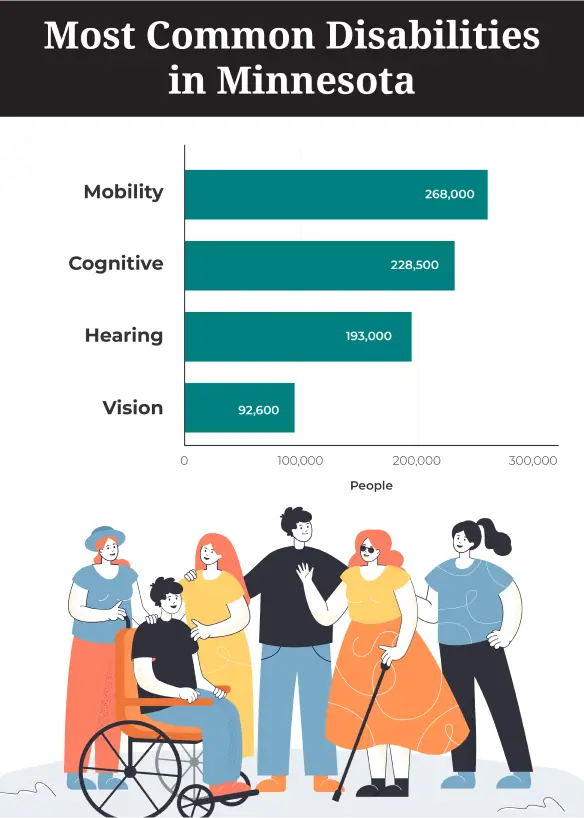
According to trends from Minnesota Go’s analysis, the most common disabilities in the state include the following:
Mobility disabilities — 268,000 people
- Many older Minnesotans, especially those 65 and older, struggle with mobility due to decreased lower-body strength.
Cognitive disabilities — 228,500 people
- Disabilities related to cognitive functioning may stem from a range of physical, mental, or emotional conditions, including stroke, dementia, traumatic brain injury, or learning disorders.
Hearing disabilities — 193,000 people
- Like mobility issues, hearing disabilities are often associated with the older population in Minnesota. Around 10% of Minnesotans, especially older adults and rural populations, experience at least mild hearing loss due to age-related hearing decline or occupational noise exposure.
Vision disabilities — 92,600 people
- Problems with sight usually manifest from conditions like macular degeneration, glaucoma, cataracts, or diabetic retinopathy. These are commonly age-related or chronic disease‑driven.
$8.05M
VERDICT
Our client was a pipefitter who had been exposed to asbestos while working at a refinery. Sieben Alexander filed a lawsuit on his behalf, resulting in an $8,050,000 jury verdict.
$5M
SETTLEMENT
A retired Minneapolis pipefitter developed an asbestos-related illness after working with asbestos-containing equipment and defective protective masks. Our attorneys recovered over $5,000,000 for him before the case reached trial.
$4.6M
SETTLEMENT
A Northern States Power Company (NSP) worker was exposed to asbestos from gaskets. Our firm secured a $4,600,000 jury award that was successfully affirmed by the Minnesota appellate courts.
$4.6M
SETTLEMENT
Our client was a retired certified public accountant who spent just one summer in the late 1950s working as an asbestos insulator. Sieben Alexander represented him in a 2014 lawsuit, securing a $4,600,000 jury award.
$4.6M
SETTLEMENT
Our client developed mesothelioma after working with asbestos-containing pipe covering for only a few months during the construction of a power plant. Our firm, alongside co-counsel, obtained a verdict of more than $4,000,000 against the product manufacturer.
$3M
SETTLEMENT
A local man was severely injured in a work-related explosion. Sieben Alexander, P.A. pursued a legal claim on his behalf, recovering over $3,000,000.
$3M
SETTLEMENT
Our client, a retired Twin Cities pipefitter was diagnosed with mesothelioma in 2019 following decades of asbestos exposure. Sieben Alexander recovered $3,000,000 on behalf of the retired worker and his wife.
$2.5M
SETTLEMENT
A local couple sustained severe injuries in a car crash. Our firm represented the couple in their case against the responsible parties, resulting in a recovery of over $2,500,000.
$1.6M
SETTLEMENT
A local woman was severely injured in a car crash. Sieben Alexander, P.A. navigated multiple layers of insurance coverage to secure a recovery of over $1,600,000.
$1.35M
SETTLEMENT
A victim suffered severe burns during a service station explosion. The firm negotiated on behalf of the victim, achieving a $1,350,000 settlement.
$1.25M
SETTLEMENT
A woman tragically lost her life in a car crash. Sieben Alexander represented her family in a wrongful death claim, recovering $1,250,000.

Lisa and I have been very happy with John and his law firm [Sieben Alexander, P.A.]. His attention to detail is unmatched. This is our first time dealing with an injury lawsuit and John and Joleen have been great reassuring us through every step in the process. I would highly recommend John to anyone needing legal help. Top notch!!
Ken
Working with John and Alex was a breeze. They took the time to help be prepared for the deposition, planned ahead with 3rd party Doctor assessments, and obtained a very suitable resulting settlement. I would definitely refer their services to anyone that needed it.
Mark M.
Working with John and Alex was a breeze. They took the time to help be prepared for the deposition, planned ahead with 3rd party Doctor assessments, and obtained a very suitable resulting settlement. I would definitely refer their services to anyone that needed it.
Mark M.
Working with John and Alex was a breeze. They took the time to help be prepared for the deposition, planned ahead with 3rd party Doctor assessments, and obtained a very suitable resulting settlement. I would definitely refer their services to anyone that needed it.
Mark M.
Working with John and Alex was a breeze. They took the time to help be prepared for the deposition, planned ahead with 3rd party Doctor assessments, and obtained a very suitable resulting settlement. I would definitely refer their services to anyone that needed it.
Mark M.
Working with John and Alex was a breeze. They took the time to help be prepared for the deposition, planned ahead with 3rd party Doctor assessments, and obtained a very suitable resulting settlement. I would definitely refer their services to anyone that needed it.
Mark M.
Working with John and Alex was a breeze. They took the time to help be prepared for the deposition, planned ahead with 3rd party Doctor assessments, and obtained a very suitable resulting settlement. I would definitely refer their services to anyone that needed it.
Mark M.
Working with John and Alex was a breeze. They took the time to help be prepared for the deposition, planned ahead with 3rd party Doctor assessments, and obtained a very suitable resulting settlement. I would definitely refer their services to anyone that needed it.
Mark M.
Working with John and Alex was a breeze. They took the time to help be prepared for the deposition, planned ahead with 3rd party Doctor assessments, and obtained a very suitable resulting settlement. I would definitely refer their services to anyone that needed it.
Mark M.
Working with John and Alex was a breeze. They took the time to help be prepared for the deposition, planned ahead with 3rd party Doctor assessments, and obtained a very suitable resulting settlement. I would definitely refer their services to anyone that needed it.
Mark M.
Have Questions About Your Case? We’re Here to Help.
Call 651-362-2108 today for a free consultation.
Employment of People With Disabilities in Minnesota
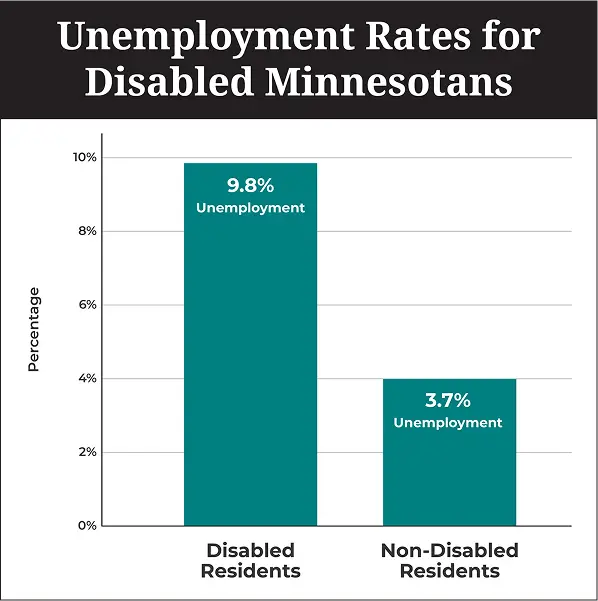
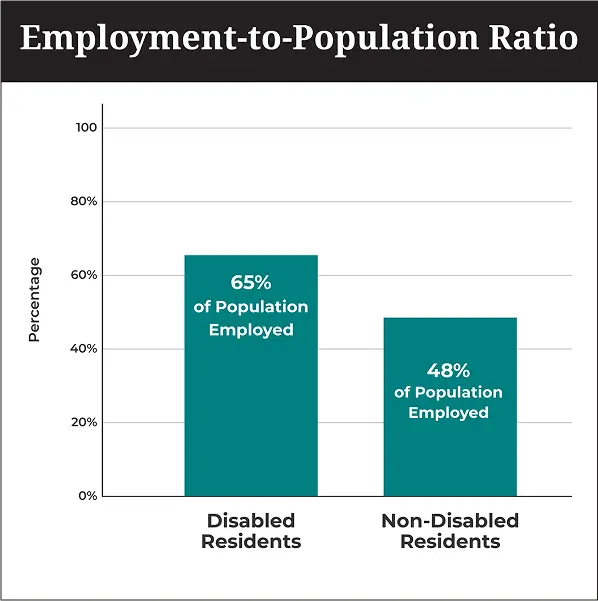
Of the individuals ages 16 and older in Minnesota with disabilities, approximately 158,000 are part of the civilian, noninstitutionalized labor force. The unemployment rate for those with disabilities in the state is 9.8%, compared to 3.7% for non-disabled residents. Overall, the employment-to-population ratio for Minnesotans with disabilities is 48%, significantly higher than the national average.
Several programs are in place to promote employment for Minnesotans with disabilities, including the 2014 Employment First policy. This policy emphasizes competitive, integrated employment—whether full-, part-, or self-employment at competitive wages—as the primary and anticipated outcome for working-age individuals with disabilities.
E1MN, a partnership across multiple state agencies, operationalizes the Employment First policy to support youth and adults with disabilities. It ensures better coordination of services—such as planning, training, and benefits counseling- and aims to increase the employment rate for people with disabilities in Minnesota.
Minnesota Disability Benefits and Resources
The United States offers federal programs to benefit individuals with disabilities across the country, such as:
- Social Security Disability Insurance, SSDI: A federal benefit for individuals who have worked, paid Social Security taxes, and now have a disabling condition that prevents substantial gainful activity.
- Supplemental Security Income, SSI: A needs-based program providing monthly cash support to low-income disabled individuals and seniors.
Additionally, Minnesota provides state-based programs for disabled residents, including the following:
- Minnesota Supplemental Aid, MSA: Provides a state cash supplement to SSI recipients who are older, have visual impairments, or have disabilities.
- Medical Assistance for Disabled Minnesotans, Medicaid: Delivers health coverage to individuals with disabilities who qualify for SSI, or through income eligibility.
- Disability Determination Services, DDS: A DEED-managed agency responsible for making medical eligibility determinations for SSDI and SSI applications in Minnesota.

How Can We Help?
"*" indicates required fields
Laws Protecting the Rights of Disabled Minnesotans
There are legal protections in place for people with disabilities under the Americans with Disabilities Act, also known as the ADA, and Minnesota-specific laws. The ADA was enacted in 1990 and amended in 2008. It prohibits discrimination and mandates equal access in employment, public services, and public accommodations.
For employers with 15 or more employees, the company must provide reasonable accommodations, such as modified work schedules and assistive technology. In addition, it forbids disability discrimination during hiring, promotion, or firing decisions.
The Minnesota Human Rights Act bans discrimination based on disability in several different areas, including employment, public services and accommodations, education, and housing. Minnesota’s accessibility laws require disability-friendly access and signage for public buildings and schools.
No-Obligation Consultation
Every case begins with a free consultation. We listen to your experience, understand its impact, and identify what you need to move forward with your case.
Open & Honest Communication
You will have direct access to the team working on your case. We maintain open communication and keep you informed about your case at every stage.
No-Fees Unless We Win
From day one, we are fully committed to your case. We gather evidence, negotiate with insurers, and prepare for trial if necessary. You pay nothing unless we secure compensation for you.





Minnesota Disability Frequently Asked Questions (FAQs)
What Percentage of Minnesotans Have a Disability?
According to the MN Compass, roughly 668,000 Minnesotans, about 12% of the state’s population, report having at least one disability.
How Many People With Disabilities Are Employed in Minnesota?
Around 158,000 disabled Minnesotans are part of the civilian, noninstitutionalized labor force, and the employment-to-population ratio for those with disabilities is 48%.
What Are the Most Common Disabilities in Minnesota?
The most common disabilities in Minnesota involve mobility challenges, affecting 268,000 individuals. Following this, cognitive disabilities impact 228,500 Minnesotans. Many residents also face hearing and visual disabilities.
How Can I Apply for Disability Benefits in Minnesota?
There are several primary programs you can apply for to receive disability benefits in Minnesota. These include SSDI, SSI, Minnesota Supplemental Aid, and Medicaid. For SSDI and SSI federal programs, you will need to apply online, by phone, or in person.
To apply for Minnesota Supplement Aid or Medicaid, you can visit the official website or seek assistance from Disability Hub MN. The application process may require you to provide medical records, employment history, and other relevant information.
Are There Resources for People With Disabilities in Minnesota?
Yes, there are numerous resources available to individuals with disabilities in Minnesota. The Disability Hub MN offers a statewide resource network for people with disabilities, their families, and professionals. They can provide information on housing, work, benefits, health, and more.
Additionally, the Minnesota Department of Human Services oversees many of the major programs in the state. It can help you navigate the process of applying for these. Lastly, Vocational Rehabilitation Services helps Minnesotans with disabilities prepare for, find, and maintain employment.