
Minnesota Asbestos Exposure Sites: A Complete Guide by County and Industry
Home | Minnesota Asbestos Exposure Sites by County and Industry
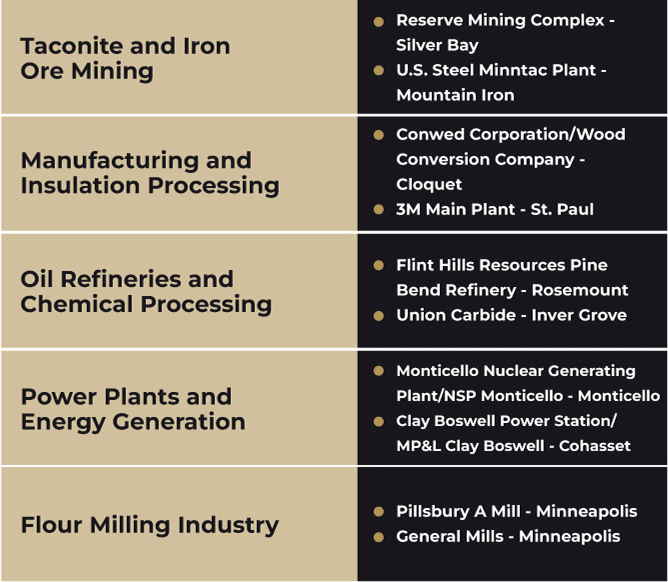
- Asbestos exposure in Minnesota has been linked to major industries, including taconite mining, manufacturing, refining, power generation, shipbuilding, and flour milling.
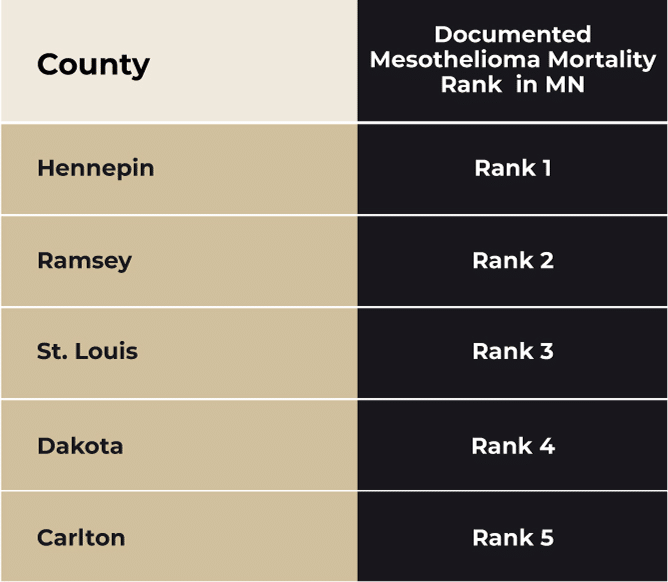
- Known asbestos exposure sites can be found across the state, including job sites in Hennepin, Ramsey, St. Louis, Dakota, and Carlton counties.
- Several Minnesota Superfund and cleanup sites illustrate how industrial contamination has created long-term public health concerns.
- Secondary asbestos exposure could have affected family members when workers accidentally brought home asbestos dust.
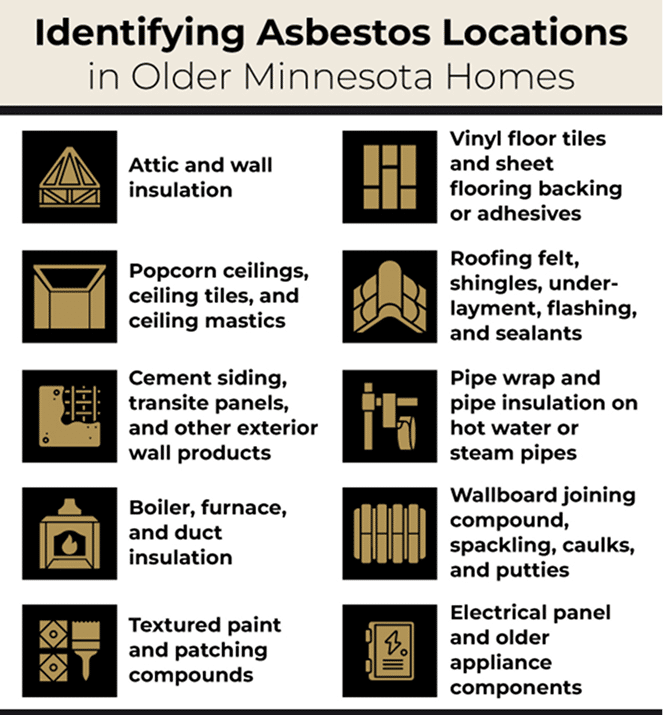
- Older Minnesota homes may still contain asbestos in appliances and building materials.
Top Industries Responsible for Asbestos Exposure in Minnesota
Throughout the 20th century, Minnesota’s economy relied on industries that regularly used asbestos for its durability and heat-resistant properties, creating exposure risks for workers across the state. Below are some of the industries most commonly associated with asbestos exposure in our state.

Taconite and Iron Ore Mining in The Iron Range
During the 20th century, northern Minnesota’s Iron Range shifted from high-grade ore mining to taconite production. Large-scale taconite operations grew in the mid-1900s through companies such as Reserve Mining and Erie Mining. By 1979, there were seven taconite plants operating across the Iron Range. These facilities used heavy machinery and high-heat systems that often contained asbestos insulation, gaskets, brakes, and other durable materials.
The industry also became the focus of United States v. Reserve Mining, which challenged Reserve Mining’s discharge of taconite tailings from Silver Bay into Lake Superior. Reserve Mining ended lake discharge in 1980 after completing an on-land disposal system.
Minnesota job sites in the mining industry associated with asbestos exposure include:
- Erie Mining Company – Hoyt Lakes
- Hibbing Taconite Company
- Minorca Mine – Virginia
- Reserve Mining Complex – Silver Bay
- United Taconite (UTAC) – Eveleth
- Thunderbird Mine – Eveleth
- United States Minntac Plant – Mountain Iron
- United States Steel (USX) – Hibbing
- United States Steel (USX) – Mountain Iron
- United States Steel (USX) – Virginia
Manufacturing and Insulation Processing Plants
Manufacturing facilities created another major pathway for asbestos exposure in Minnesota. Some plants processed materials that contained asbestos. Others used asbestos-containing insulation, fireproofing, adhesives, building materials, or equipment components in production areas, laboratories, powerhouses, and maintenance departments.
In Cloquet, Conwed Corporation and its predecessor, Wood Conversion Co., are especially important because state health materials identify the site as a former manufacturer of asbestos-containing ceiling tiles and other related products.
Processing plants associated with asbestos exposure include:
- Conwed Corporation/Wood Conversion Company – Cloquet
- Conwed Corporation – Red Wing
- Conwed Plastics – Minneapolis
- 3M Main Plant – St. Paul
- 3M Chemolite
- 3M Powerhouse
- 3M Research facilities
- 3M Minneapolis facilities
- Asbestos Insulation Supply – Minneapolis
- Insulation Sales Corporation
Oil Refineries and Chemical Processing
Refineries and chemical plants relied on asbestos because their equipment had to withstand intense heat, pressure, and fire risk. Workers could be exposed when older insulation, gaskets, valves, or other asbestos-containing materials were removed or disturbed during maintenance and plant upgrades.
In Minnesota, the Pine Bend area and other chemical-processing sites show that asbestos exposure extended beyond mining and manufacturing into refinery, utility, and chemical-plant work.
Minnesota job sites in these industries associated with asbestos exposure include:
- Flint Hills Resources Pine Bend Refinery – Rosemount
- Koch Refining Office – Pine Bend
- Koch Asphalt
- Koch Sulfur Products
- Pine Bend Peaking Station
- Union Carbide – Inver Grove
- Universal Oil Products
- Northern Petrochemical
- North Star Chemical
- Stauffer Chemical
Power Plants and Energy Generation
Power plants and municipal utilities used asbestos because systems had to withstand constant heat, steam, and electrical demand. Workers could be exposed when insulation, fireproofing, or other asbestos-containing materials were disturbed during repairs, outages, upgrades, or demolition.
In Minnesota, these risks were especially relevant at older power plants, steam plants, and utility facilities where boilers, turbines, and pipe systems were central to daily operations.
Minnesota power plants and energy generation facilities associated with asbestos exposure include:
- Monticello Nuclear Generating Plant/NSP Monticello – Monticello
- Allen S. King Plant/NSP King – Oak Park Heights
- NSP Becker/Sherburne-area power plant – Becker
- Black Dog Generating Station/NSP Black Dog – Burnsville
- Prairie Island Nuclear Generating Plant/NSP Prairie Island – Red Wing
- High Bridge Generating Station/NSP Highbridge – St. Paul
- Riverside Generating Plant/NSP Riverside – Minneapolis
- Clay Boswell Power Station/MP&L Clay Boswell – Cohasset
- Hibbard Renewable Energy Center/MP&L Hibbard – Duluth
- Taconite Harbor Energy Center
- Hibbing Public Utilities/Hibbing Power Plant
The Flour Milling Industry: The Mill City Era
Minneapolis became known as the “Flour Milling Capital of the World” during the city’s industrial peak. Massive mills, grain elevators, rail connections, and power systems were clustered around St. Anthony Falls. These facilities depended on steam, heat, and fire-resistant building materials to keep production running in a dusty industrial environment. When asbestos was used in insulation, fireproofing, or mechanical systems, mill workers and maintenance crews were at risk of exposure.
Flour mills in Minnesota associated with asbestos exposure include:
- Pillsbury A Mill – Minneapolis
- Pillsbury Building – Minneapolis
- Pillsbury Center – Minneapolis
- Pillsbury Research & Development
- General Mills – Minneapolis
- General Mills Betty Crocker Building – Minneapolis
- General Mills Bell Research
- Flour Exchange Building – Minneapolis
- Grain Exchange – Minneapolis
Minnesota Asbestos Exposure Sites by County
Asbestos exposure in Minnesota was not limited to a single industry or region. County-level patterns help show how exposure occurred in different ways, from vermiculite processing in Minneapolis and insulation distribution in St. Paul to mining, shipbuilding, power generation, and manufacturing in northern Minnesota. The counties below highlight some of the best-documented asbestos exposure sites and the industries that shaped local risk.
Hennepin County Asbestos Sites
Hennepin County’s asbestos history is closely tied to the older commercial buildings and the former Western Mineral Products/W.R. Grace plant. The Minneapolis plant processed vermiculite ore from Libby, Montana, from 1938 to 1989. The ore contained asbestos and was heated through an exfoliation process. This process expanded the vermiculite for use in Zonolite insulation and other products.
Waste material known as “crush rock” or “stoner rock” was left outside the plant and made available to the public. Residents used it in yards, gardens, driveways, barbecues, and construction projects. Children also played on the piles, creating community exposure concerns beyond the plant itself. Concerns about waste from the plant seeping into the surrounding community also arose.
The EPA lists Western Mineral Products in its Superfund database as a removal-only site, and it is not on the National Priorities List.
Hennepin County asbestos sites include:
- Western Mineral Products/Zonolite Plant
- Honeywell Facilities – Minneapolis and surrounding metro locations
- Dunwoody Institute – Minneapolis
- General Mills and Pillsbury facilities – Minneapolis
- IDS Center – Minneapolis
Ramsey County Asbestos Sites
Ramsey County’s asbestos history reflects St. Paul’s role as an industrial, manufacturing, and distribution hub. MacArthur Company is especially notable because the company began as a pipe insulation manufacturer and remains connected to mechanical insulation distribution. The county also includes major 3M facilities, older utility sites, and military production facilities where asbestos-containing materials may have been used in buildings, equipment, or industrial systems.
Ramsey County asbestos sites include:
- MacArthur Company – St. Paul
- MacArthur Warehouse – St. Paul
- 3M Main Plant – St. Paul
- 3M Powerhouse and research facilities – St. Paul
- Twin City Arsenal – Arden Hills area
- U.S. Gypsum – St. Paul
St. Louis County Asbestos Sites
St. Louis County combined two major exposure settings: Iron Range mining and Twin Ports maritime work. Mining and taconite operations involved heavy industrial systems that could contain asbestos materials, while shipbuilding and ship repair often placed workers near insulated pipes, boilers, engines, and other mechanical systems in tight vessel spaces. Historic shipbuilding activity in the Duluth area also supports the county’s maritime exposure history.
St. Louis County asbestos sites include:
- Shipyards – Duluth
- Shipyards – Walter Butler – Duluth
- Ore Docks – Duluth
- U.S. Steel – Morgan Park
- Hibbing Utility Commission
- Mining – U.S. Steel
- U.S. Minntac Plant
- Several DM & IR railroad sites
Dakota County Asbestos Sites
Dakota County’s asbestos exposure history is closely tied to refineries, power generation, and chemical plant work. Pine Bend in Rosemount is one of Minnesota’s most prominent refinery areas. Other Dakota County sites show how asbestos exposure could occur in chemical plants, utility facilities, wastewater systems, and infrastructure work.
Dakota County asbestos sites include:
- Flint Hills Resources Pine Bend Refinery
- Koch Refining/Pine Bend facilities
- Koch Asphalt and Koch Sulfur Products
- Pine Bend Peaking Station
- Black Dog Generating Station – Burnsville
- Union Carbide – Inver Grove
- Ammonia Plant – Burnsville
Carlton County Asbestos Sites
In asbestos exposure history, Carlton County is one of Minnesota’s most important counties. Conwed Corporation and Wood Conversion Company in Cloquet. MDH states that asbestos was used at the Cloquet plant to produce ceiling tiles and other products, making the site central to the county’s manufacturing exposure history.
Carlton County asbestos sites include:
- Conwed Corporation/Wood Conversion Company – Cloquet
- Chipboard/Stud Mill Plant – Cloquet
- Potlatch Paper Mill – Cloquet
- Northwest Paper Mill – Cloquet
- Diamond Match – Cloquet
- Cloquet-area schools and public buildings
Notable Superfund and Cleanup Sites Across Minnesota
Superfund sites illustrate how industrial contamination remains a public health concern long after a facility closes or changes ownership. EPA’s Superfund program addresses contaminated manufacturing facilities, processing plants, landfills, mining sites, and other properties where hazardous substances were dumped, released, or left behind.
In Minnesota, these sites include scrap yards, refineries, landfills, wood-treatment facilities, and vermiculite-processing operations, all of which are linked to broader histories of asbestos and industrial exposure.
Agate Lake Scrap Yard
The Agate Lake Scrap Yard site is located on the western shore of Agate Lake in Fairview Township, Cass County. EPA identifies the property as an 8-acre former scrap yard that operated from 1952 to 1982 and handled scrap iron, metal, and transformers.
Site operations contaminated soil and groundwater with hazardous chemicals, and cleanup actions included the removal of asbestos-containing pipe insulation along with contaminated soil, ash, slag, transformers, and waste materials. EPA removed the site from the National Priorities List in 1997 after successful cleanup efforts.
Olmsted County Sanitary Landfill
The Olmsted County Sanitary Landfill near Oronoco operated as a landfill beginning around 1970 and accepted municipal, commercial, and industrial solid waste until 1987. The EPA states that waste disposal operations contaminated groundwater with hazardous chemicals, and the site was later capped with a leachate collection system.
The EPA also notes that the landfill accepted industrial wastes, including asbestos, transformers, paint, solvents, and electroplating sludge. The EPA removed the site from the National Priorities List in 1995. However, operation and maintenance activities continue through Minnesota’s Closed Landfill Program.
Koch Refining Co./N-Ren Corp.
The Koch Refining Co./N-Ren Corp. site in Rosemount is part of the Pine Bend refinery area. The EPA states that spills from refining and transport operations contaminated soil and groundwater with hazardous chemicals. The active Pine Bend Refinery now operates at the site under Flint Hills Resources Pine Bend, LLC, with cleanup oversight by the Minnesota Pollution Control Agency. This site connects Dakota County’s refinery history to Minnesota’s broader industrial contamination record.
Western Mineral Products Vermiculite Site
The former Western Mineral Products plant at 1720 Madison St. NE in Minneapolis processed vermiculite ore from Libby, Montana, from 1938 to 1989. The ore contained hazardous asbestos and was heated through an exfoliation process that expanded the vermiculite for use in insulation and other products. The EPA lists Western Mineral Products in its Superfund database as a removal-only site, not a National Priorities List site.
Secondary Asbestos Exposure in Minnesota: Risks to Families and Loved Ones
Asbestos exposure was not always limited to the person who worked directly with asbestos-containing materials. In Minnesota, families may have been exposed to asbestos through household contact, community exposure, or older residential materials that remained in place long after asbestos use declined.
Take-Home Asbestos Exposure
Take-home asbestos exposure happened when workers returned home with asbestos dust on their clothes, boots, skin, or hair. According to the Agency for Toxic Substances and Disease Registry (ATSDR), workers’ families and other household contacts could be exposed by breathing in asbestos dust from contaminated clothing or during laundering.
In a state with a long history of mining, manufacturing, insulation work, shipbuilding, and refinery work, that kind of household exposure is an important part of Minnesota’s asbestos story.

Residential Hazards in Older Minnesota Homes and Buildings
Asbestos can remain in older Minnesota homes, especially homes built or remodeled before the early 1980s, when asbestos-containing building products were still widely used. The Minnesota Department of Health says asbestos was used in more than 3,000 construction materials and manufactured products, many of which were found in homes. The EPA explains that fibers can be released when asbestos-containing materials are disturbed during maintenance, repairs, remodeling, or demolition.
In other words, asbestos in good condition may not pose an immediate risk. However, cutting, sanding, drilling, scraping, or removing older materials can release toxic fibers into the air.
Pursuing Your Legal Rights After a Mesothelioma Diagnosis in Minnesota
A mesothelioma diagnosis often leads to questions that are difficult to answer alone. Understanding where the exposure happened, how long ago it occurred, and which companies may have been involved, can leave you wondering how you can even begin to seek justice. That confusion is understandable, especially when asbestos exposure likely happened decades ago.
A Minnesota asbestos lawyer can help answer those questions and ease your concerns by gathering evidence and piecing together your work history. Sieben Alexander, P.A. is Minnesota’s only mesothelioma law firm, helping individuals and families throughout Minnesota, Wisconsin, and North Dakota understand their legal options after an asbestos-related diagnosis. If you have questions about a diagnosis or a loved one’s past exposure, you can contact our team today to discuss your legal options.